> ## Documentation Index
> Fetch the complete documentation index at: https://docs.textql.com/llms.txt
> Use this file to discover all available pages before exploring further.
# Desktop App
> Install and use TextQL as an app on your Mac, Windows, or Linux computer
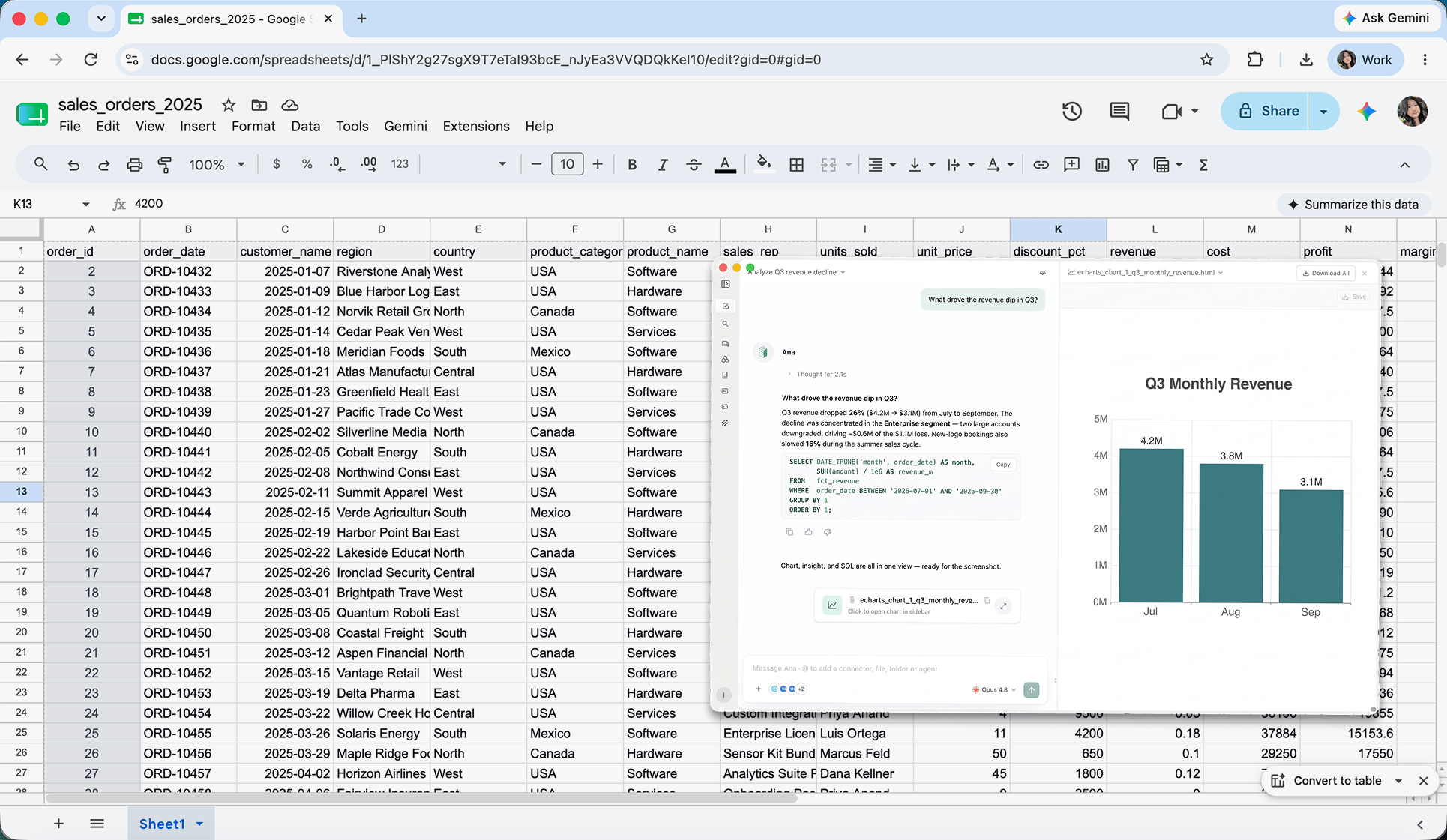
## Your analysis, in its own window
Keep chats, dashboards, and playbooks side by side, move between them with real tabs, and reach TextQL from your dock instead of hunting through browser tabs. Available for Mac, Windows, and Linux.
 Get the right build for your computer from **Settings → Desktop App**.
Install, sign in, and send your first message in four steps.
## Why use it
The app has its own tabs, separate from your browser's. Keep a dashboard in one tab and a chat in another without losing either among thirty browser tabs.
Open a second window and put a dashboard on one monitor while you work in a chat on the other.
TextQL sits in your dock or taskbar like any other app. On Mac and Windows it also adds a menu bar or system tray icon with **Show TextQL** and **New Chat**.
It uses the same account and the same data as the website. Nothing moves, and anything you make in one shows up in the other.
## Get started with the desktop app
Open TextQL in your browser, go to **Settings → Desktop App**, and click **Recommended for you**. The page works out which computer you're on and offers the right download. If it guesses wrong, pick yours from the **All Platforms** list underneath.
See [Installing](#installing) for what to do with the file once it downloads.
Sign in with the same details you use on the website. If your company uses single sign-on, a browser window opens so you can sign in there, then sends you back to the app automatically.
Your chats, dashboards, playbooks, connectors, and ontology are down the left side, exactly as they are on the web. Pick up an existing chat or start a new one with `⌘N` (`Ctrl+N` on Windows and Linux).
Ask Ana a question in the composer. Answers, SQL, charts, and dashboards all open in the same window — see [Your First Chat](/core/get-started/your-first-chat) if you're new to TextQL.
## Use the desktop app when…
* You keep TextQL open all day and want it out of your browser
* You watch a dashboard on one screen while you work in a chat on another
* You want a new chat one keystroke away from anywhere on your computer
* Your company runs TextQL at its own web address and you'd rather not retype it
## Installing
Open the file you downloaded. Drag the TextQL icon into your Applications folder, then open it from there.
There's no published minimum macOS version — if you're on a computer several years old, see [Desktop App Rollout](/core/admin/desktop-app#supported-platforms) or check with whoever manages TextQL where you work.
You need **Windows 10 or newer, 64-bit**.
Open the file you downloaded and follow the steps on screen. You don't need admin rights. TextQL will then be in your Start menu.
You can download either an AppImage or a `.deb`. Install the `.deb` the normal way for your system.
For the AppImage, you first need to make it runnable: right-click it, choose **Properties**, and tick the box that allows running it as a program. (Or run `chmod +x` on it in a terminal.)
Linux doesn't get the system tray icon, and there's no published minimum — see [Desktop App Rollout](/core/admin/desktop-app#supported-platforms).
**Don't see a Download option?** Two reasons this happens:
* **You're already in the desktop app.** The page only appears in a web browser. Open TextQL in your browser instead.
* **Your company turned the page off** and hands the app out itself. Ask whoever manages TextQL where you work — see [Desktop App Rollout](/core/admin/desktop-app).
## Connecting to your own server
If your company runs TextQL at its own web address, go to **File → Change Server…** and choose **Custom Server…**, then enter that address. The same menu switches you back to **TextQL Cloud**. Whoever manages TextQL where you work may also send you a setup link that does this for you.
## Links that open in the app
Once the app is installed, `textql://` links open in it instead of your browser. You can put these in a message or a bookmark:
| Link | What it does |
| ---------------------------------------------------- | --------------------------------------- |
| `textql://chat/{chatId}` | Opens that chat in the current tab |
| `textql://dashboard/{dashboardId}` | Opens that dashboard in the current tab |
| `textql://connect?server=https://textql.example.com` | Points the app at a different server |
Chat and dashboard links open in whichever server the app is currently pointed at, so they only work if you're signed in to the deployment the item lives on.
## Finding your way around
It looks like the website. The difference is the menu bar at the top, with the usual File, Edit, View, and Window menus — new tabs and windows, reload, zoom, and full screen all live there.
| To do this | On a Mac | On Windows or Linux |
| ----------------------------- | ------------ | ----------------------- |
| Start a new chat | `⌘N` | `Ctrl+N` |
| Open a new tab | `⌘T` | `Ctrl+T` |
| Open a new window | `⌘ Shift N` | `Ctrl+Shift+N` |
| Close the tab you're on | `⌘W` | `Ctrl+W` |
| Move to the next tab | `Ctrl+Tab` | `Ctrl+Tab` |
| Jump straight to a tab | `⌘1` to `⌘8` | `Ctrl+1` to `Ctrl+8` |
| Jump to the last tab | `⌘9` | `Ctrl+9` |
| Reload the page | `⌘R` | `Ctrl+R` |
| Make things bigger or smaller | `⌘+` or `⌘-` | `Ctrl+Plus` or `Ctrl+-` |
## Updates
The app checks for updates when you open it, and again every four hours. **It asks before doing anything** — it won't download or restart behind your back.
What you see depends on how the update was found:
* **The app found it on its own.** You get an **Update Available** notification from your computer, saying the new version is available and to click to download. Clicking the notification starts the download; ignoring it does nothing.
* **You checked yourself.** You get a box in the app with **Download** and **Later**. Nothing downloads until you choose Download. If you're already up to date, it tells you that instead.
Either way, once the update has downloaded you get an **Update Ready** box asking to **Restart** now or **Later**. If you choose Later, the update installs by itself the next time you quit the app.
To check whenever you like:
* **On a Mac** — **TextQL → Check for Updates…**
* **On Windows and Linux** — **Help → Check for Updates…**
The newest version you can get is the one your company's TextQL is running, so a brand-new release reaches you once whoever manages TextQL where you work has updated it.
## Troubleshooting
Your Mac may block it the first time. Go to **System Settings**, then **Privacy & Security**, scroll down, and click **Open Anyway**.
Check that your computer's clock is showing the right time. Then sign out, close the app completely, open it again, and sign in.
Go to the **View** menu and click **Reload**. If it's still blank, open the same thing in your web browser. If it's blank there too, the problem is with the dashboard, not the app.
Check you're pointed at the right place under **File → Change Server…**. You may also need to be connected to your work VPN — check with whoever manages TextQL where you work.
## Other ways to use TextQL
Ask Ana and get scheduled reports in the channels you already work in.
Run playbooks and share answers from a Teams channel or chat.
Put Ana inside your own product or internal tool.
Reach your TextQL data from Claude, Cursor, and other MCP clients.
## Need Help?
Contact whoever manages TextQL where you work, or [support@textql.com](mailto:support@textql.com). Tell them what you were doing when it went wrong, and which computer you're using — Mac, Windows, or Linux.
Mac users: you can also find the exact app version under **TextQL → About TextQL**. This isn't available on Windows or Linux yet, so don't worry if you can't find it.
Get the right build for your computer from **Settings → Desktop App**.
Install, sign in, and send your first message in four steps.
## Why use it
The app has its own tabs, separate from your browser's. Keep a dashboard in one tab and a chat in another without losing either among thirty browser tabs.
Open a second window and put a dashboard on one monitor while you work in a chat on the other.
TextQL sits in your dock or taskbar like any other app. On Mac and Windows it also adds a menu bar or system tray icon with **Show TextQL** and **New Chat**.
It uses the same account and the same data as the website. Nothing moves, and anything you make in one shows up in the other.
## Get started with the desktop app
Open TextQL in your browser, go to **Settings → Desktop App**, and click **Recommended for you**. The page works out which computer you're on and offers the right download. If it guesses wrong, pick yours from the **All Platforms** list underneath.
See [Installing](#installing) for what to do with the file once it downloads.
Sign in with the same details you use on the website. If your company uses single sign-on, a browser window opens so you can sign in there, then sends you back to the app automatically.
Your chats, dashboards, playbooks, connectors, and ontology are down the left side, exactly as they are on the web. Pick up an existing chat or start a new one with `⌘N` (`Ctrl+N` on Windows and Linux).
Ask Ana a question in the composer. Answers, SQL, charts, and dashboards all open in the same window — see [Your First Chat](/core/get-started/your-first-chat) if you're new to TextQL.
## Use the desktop app when…
* You keep TextQL open all day and want it out of your browser
* You watch a dashboard on one screen while you work in a chat on another
* You want a new chat one keystroke away from anywhere on your computer
* Your company runs TextQL at its own web address and you'd rather not retype it
## Installing
Open the file you downloaded. Drag the TextQL icon into your Applications folder, then open it from there.
There's no published minimum macOS version — if you're on a computer several years old, see [Desktop App Rollout](/core/admin/desktop-app#supported-platforms) or check with whoever manages TextQL where you work.
You need **Windows 10 or newer, 64-bit**.
Open the file you downloaded and follow the steps on screen. You don't need admin rights. TextQL will then be in your Start menu.
You can download either an AppImage or a `.deb`. Install the `.deb` the normal way for your system.
For the AppImage, you first need to make it runnable: right-click it, choose **Properties**, and tick the box that allows running it as a program. (Or run `chmod +x` on it in a terminal.)
Linux doesn't get the system tray icon, and there's no published minimum — see [Desktop App Rollout](/core/admin/desktop-app#supported-platforms).
**Don't see a Download option?** Two reasons this happens:
* **You're already in the desktop app.** The page only appears in a web browser. Open TextQL in your browser instead.
* **Your company turned the page off** and hands the app out itself. Ask whoever manages TextQL where you work — see [Desktop App Rollout](/core/admin/desktop-app).
## Connecting to your own server
If your company runs TextQL at its own web address, go to **File → Change Server…** and choose **Custom Server…**, then enter that address. The same menu switches you back to **TextQL Cloud**. Whoever manages TextQL where you work may also send you a setup link that does this for you.
## Links that open in the app
Once the app is installed, `textql://` links open in it instead of your browser. You can put these in a message or a bookmark:
| Link | What it does |
| ---------------------------------------------------- | --------------------------------------- |
| `textql://chat/{chatId}` | Opens that chat in the current tab |
| `textql://dashboard/{dashboardId}` | Opens that dashboard in the current tab |
| `textql://connect?server=https://textql.example.com` | Points the app at a different server |
Chat and dashboard links open in whichever server the app is currently pointed at, so they only work if you're signed in to the deployment the item lives on.
## Finding your way around
It looks like the website. The difference is the menu bar at the top, with the usual File, Edit, View, and Window menus — new tabs and windows, reload, zoom, and full screen all live there.
| To do this | On a Mac | On Windows or Linux |
| ----------------------------- | ------------ | ----------------------- |
| Start a new chat | `⌘N` | `Ctrl+N` |
| Open a new tab | `⌘T` | `Ctrl+T` |
| Open a new window | `⌘ Shift N` | `Ctrl+Shift+N` |
| Close the tab you're on | `⌘W` | `Ctrl+W` |
| Move to the next tab | `Ctrl+Tab` | `Ctrl+Tab` |
| Jump straight to a tab | `⌘1` to `⌘8` | `Ctrl+1` to `Ctrl+8` |
| Jump to the last tab | `⌘9` | `Ctrl+9` |
| Reload the page | `⌘R` | `Ctrl+R` |
| Make things bigger or smaller | `⌘+` or `⌘-` | `Ctrl+Plus` or `Ctrl+-` |
## Updates
The app checks for updates when you open it, and again every four hours. **It asks before doing anything** — it won't download or restart behind your back.
What you see depends on how the update was found:
* **The app found it on its own.** You get an **Update Available** notification from your computer, saying the new version is available and to click to download. Clicking the notification starts the download; ignoring it does nothing.
* **You checked yourself.** You get a box in the app with **Download** and **Later**. Nothing downloads until you choose Download. If you're already up to date, it tells you that instead.
Either way, once the update has downloaded you get an **Update Ready** box asking to **Restart** now or **Later**. If you choose Later, the update installs by itself the next time you quit the app.
To check whenever you like:
* **On a Mac** — **TextQL → Check for Updates…**
* **On Windows and Linux** — **Help → Check for Updates…**
The newest version you can get is the one your company's TextQL is running, so a brand-new release reaches you once whoever manages TextQL where you work has updated it.
## Troubleshooting
Your Mac may block it the first time. Go to **System Settings**, then **Privacy & Security**, scroll down, and click **Open Anyway**.
Check that your computer's clock is showing the right time. Then sign out, close the app completely, open it again, and sign in.
Go to the **View** menu and click **Reload**. If it's still blank, open the same thing in your web browser. If it's blank there too, the problem is with the dashboard, not the app.
Check you're pointed at the right place under **File → Change Server…**. You may also need to be connected to your work VPN — check with whoever manages TextQL where you work.
## Other ways to use TextQL
Ask Ana and get scheduled reports in the channels you already work in.
Run playbooks and share answers from a Teams channel or chat.
Put Ana inside your own product or internal tool.
Reach your TextQL data from Claude, Cursor, and other MCP clients.
## Need Help?
Contact whoever manages TextQL where you work, or [support@textql.com](mailto:support@textql.com). Tell them what you were doing when it went wrong, and which computer you're using — Mac, Windows, or Linux.
Mac users: you can also find the exact app version under **TextQL → About TextQL**. This isn't available on Windows or Linux yet, so don't worry if you can't find it.