> ## Documentation Index
> Fetch the complete documentation index at: https://docs.textql.com/llms.txt
> Use this file to discover all available pages before exploring further.
# Module 4 · Track A: Explore & Reconcile
> Do: open the ontology graph and browse the file tree and a notes/*.md. Walk entities → metrics → lineage. This is your living model — readable files plus a graph, versioned and … (~25 min)
## 4.1 · Explore what you built
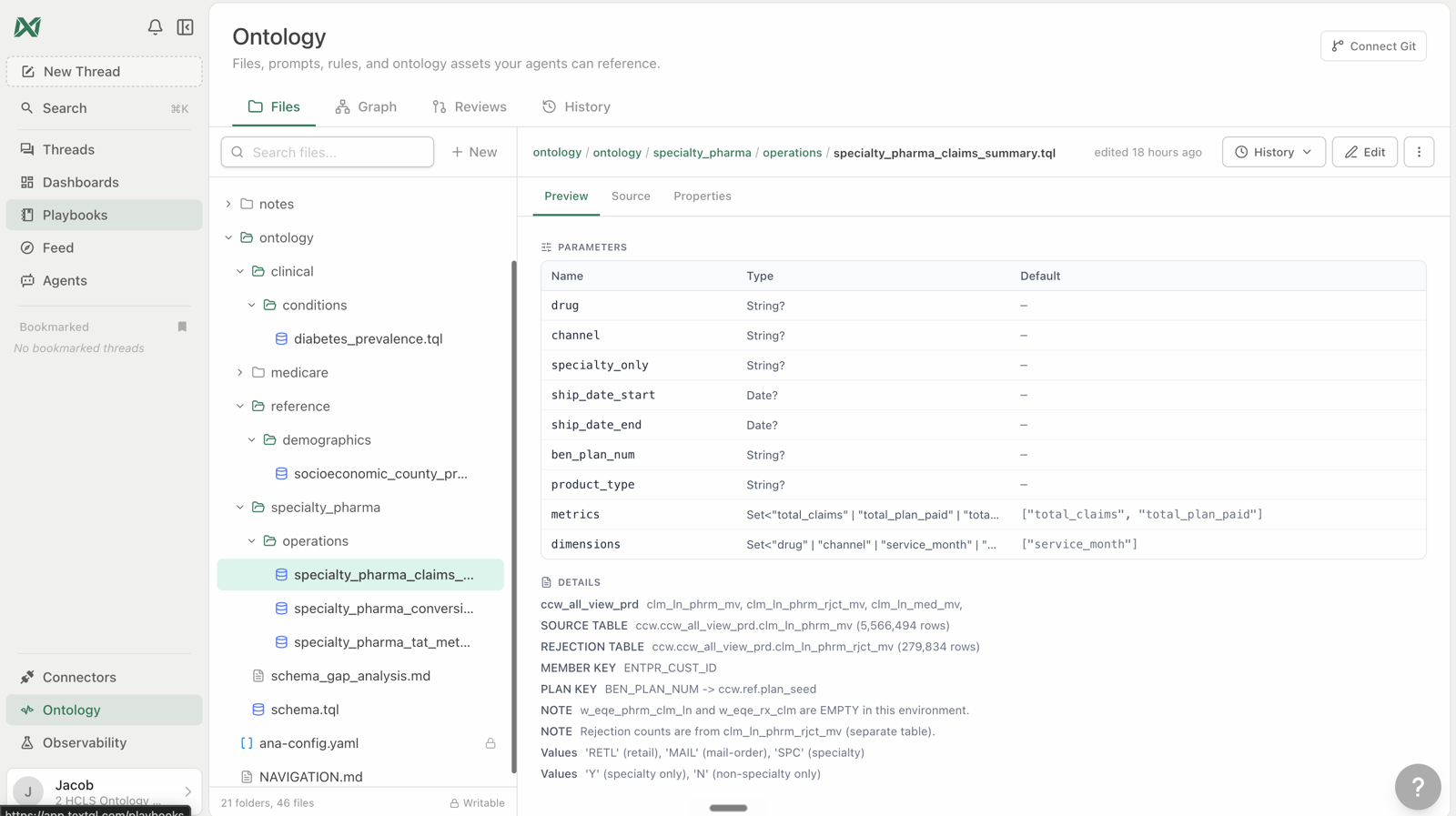
**Do:** open the **ontology graph** and browse the file tree and a `notes/*.md`. Walk entities → metrics → lineage. This is your living model — readable files plus a graph, versioned and reviewable.
 ## 4.2 · Reconcile a conflicting metric — the key moment
```text Prompt theme={null}
Two teams define this metric differently (for example, a stricter vs. broader window, or a prorated vs. full-count denominator). Inspect the data, recommend one governed definition, author it as a .tql surface, and record the decision — and the rejected alternative — in a notes file. Keep the alternative available under a separate, clearly-named metric.
```
**You'll see:** Ana identify the discrepancy, propose one definition, and produce a reviewable change. The rejected alternative stays available — renamed, not erased.
**When two SOURCES disagree — not just two definitions** —
Sometimes the conflict is upstream: a summarized table and the base tables tell different stories about the same question. Don't let Ana pick on convenience — **run the question against both, compare the results side by side, and let the SME who owns the data rule** which is the source of truth. Then record the ruling — and the caveat about the losing source — in a notes file so it never gets re-litigated, and so Ana routes to the right table next time.
**Why this matters** —
Every organization has a metric defined two ways. Governing it into one definition — with the decision recorded — is the moment the ontology stops being documentation and starts being the source of truth.
### ✅ Checkpoint
* [ ] You walked entities → metrics → lineage in the ontology graph
* [ ] A conflicting metric got one governed definition, with the decision recorded in notes/
* [ ] The rejected alternative survives under a clearly-named separate metric
## 4.2 · Reconcile a conflicting metric — the key moment
```text Prompt theme={null}
Two teams define this metric differently (for example, a stricter vs. broader window, or a prorated vs. full-count denominator). Inspect the data, recommend one governed definition, author it as a .tql surface, and record the decision — and the rejected alternative — in a notes file. Keep the alternative available under a separate, clearly-named metric.
```
**You'll see:** Ana identify the discrepancy, propose one definition, and produce a reviewable change. The rejected alternative stays available — renamed, not erased.
**When two SOURCES disagree — not just two definitions** —
Sometimes the conflict is upstream: a summarized table and the base tables tell different stories about the same question. Don't let Ana pick on convenience — **run the question against both, compare the results side by side, and let the SME who owns the data rule** which is the source of truth. Then record the ruling — and the caveat about the losing source — in a notes file so it never gets re-litigated, and so Ana routes to the right table next time.
**Why this matters** —
Every organization has a metric defined two ways. Governing it into one definition — with the decision recorded — is the moment the ontology stops being documentation and starts being the source of truth.
### ✅ Checkpoint
* [ ] You walked entities → metrics → lineage in the ontology graph
* [ ] A conflicting metric got one governed definition, with the decision recorded in notes/
* [ ] The rejected alternative survives under a clearly-named separate metric