| Layer | Controls | Example |
|---|
| **Database permissions / RLS / connector scope** | Which **rows exist** for this identity | The warehouse returns only this region's members |
| **Behavioral context (this workshop)** | Which **questions get asked** and **how answers are framed** | The persona offers only allowed surfaces, never shows SQL, declines off-scope with a redirect |
| **Platform RBAC** | Which **features and resources** are usable | Who can create connectors, edit dashboards, review patches |
They complement, never substitute: behavioral context without data-layer enforcement is politeness; data enforcement without behavioral context is a wall with no signage — technically secure and practically hostile. Defense in depth is all three (data scoping: [**Connect Your Data**](/workshops/connect-your-data/overview); platform RBAC: [**Admin & Governance**](/workshops/admin-governance/overview)).
## 6.4 · Fail closed
The default posture for restricted personas, in both design and provisioning:
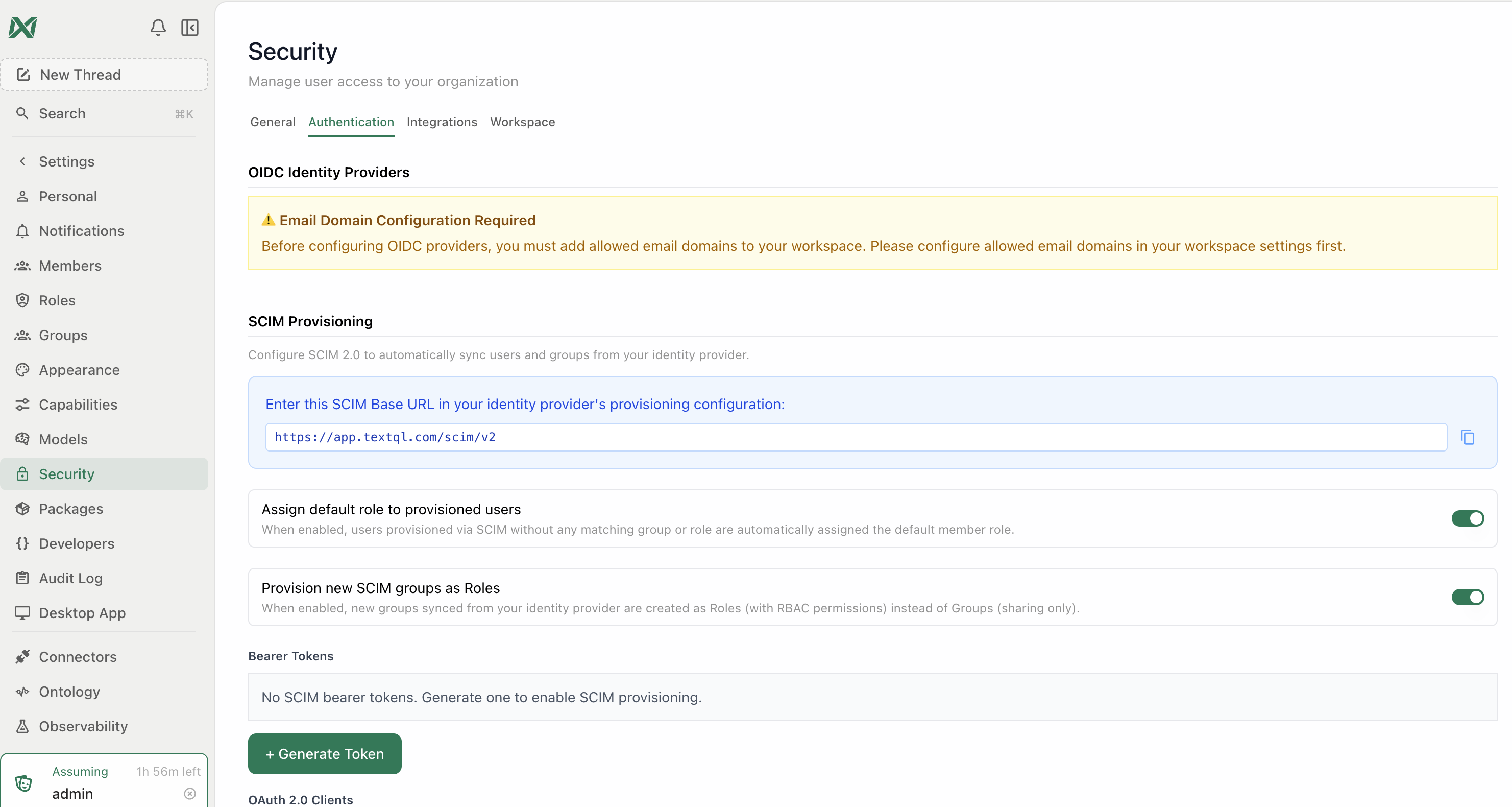
* **In the file:** the allowlist names what's permitted; everything else is denied — never the reverse. A new surface added to the ontology is *invisible* to restricted personas until explicitly added to their list.- **In provisioning:** a user with no mapped group gets the most restrictive default (or no access), not the org-wide default. Unknown identity → minimum surface.- **In review:** widening an allowlist is a reviewed change (Module 5.3); narrowing one can ship fast. Asymmetry is the point.
 ### ✅ Checkpoint
* [ ] Personas in your org are admin-provisioned — you verified a test user cannot swap their own
* [ ] The IdP-group → role → persona chain is mapped (or planned) for at least your two Module 4 personas
* [ ] You can draw the three-layer RBAC table from memory and say what each layer catches that the others miss
* [ ] Restricted personas fail closed: allowlist-based files, restrictive provisioning default, asymmetric review
### ✅ Checkpoint
* [ ] Personas in your org are admin-provisioned — you verified a test user cannot swap their own
* [ ] The IdP-group → role → persona chain is mapped (or planned) for at least your two Module 4 personas
* [ ] You can draw the three-layer RBAC table from memory and say what each layer catches that the others miss
* [ ] Restricted personas fail closed: allowlist-based files, restrictive provisioning default, asymmetric review