

4.1 · Explore what you built
Do: open the ontology graph and browse the file tree and anotes/*.md. Walk entities → metrics → lineage. This is your living model — readable files plus a graph, versioned and reviewable.
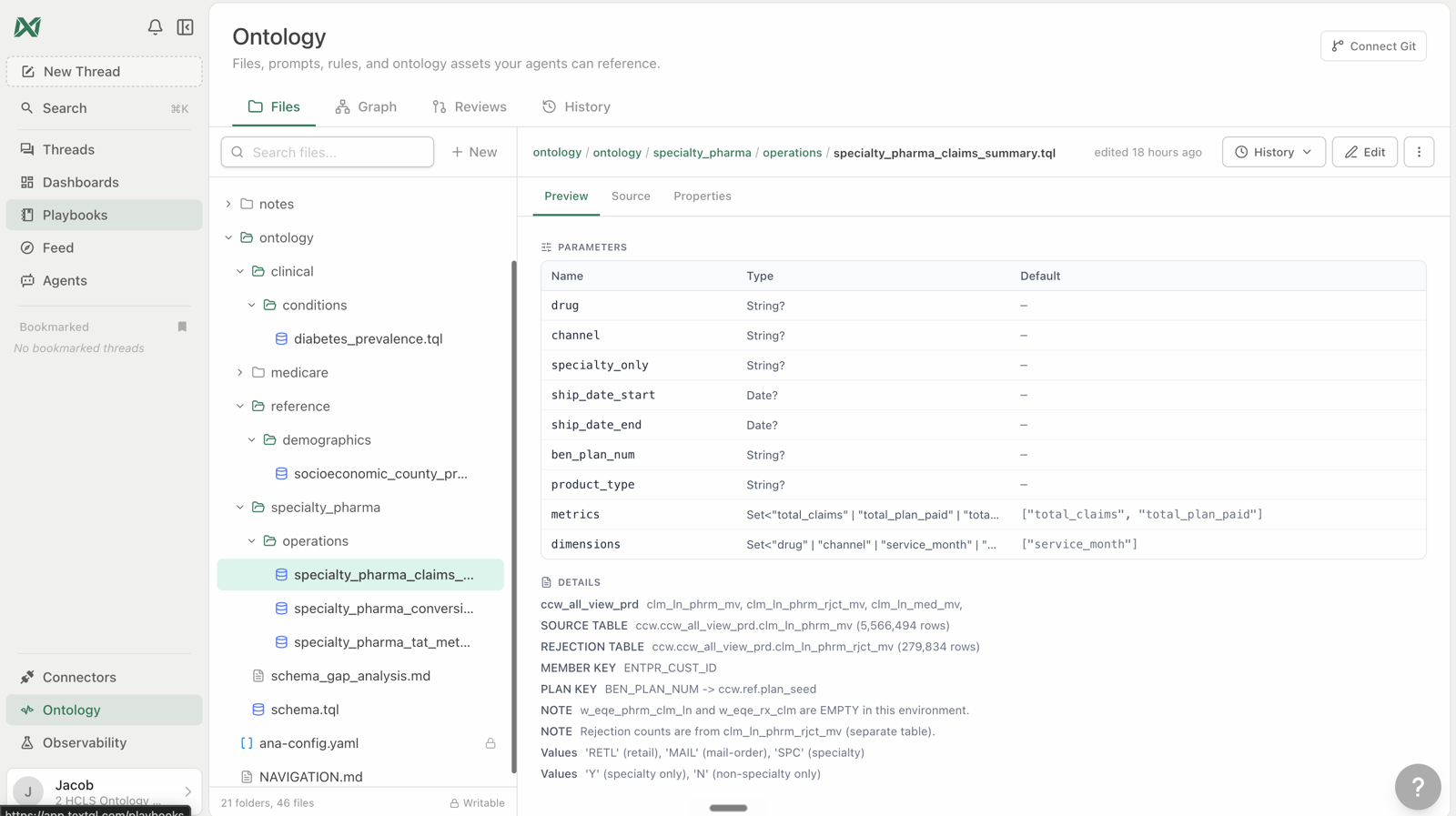
The living model: a readable file tree, and every .tql inspectable — parameters, metrics, dimensions, and the exact table backings. The Graph tab is one click away.
4.2 · Reconcile a conflicting metric — the key moment
Prompt
You’ll see: Ana identify the discrepancy, propose one definition, and produce a reviewable change. The rejected alternative stays available — renamed, not erased.
Why this matters — Every organization has a metric defined two ways. Governing it into one definition — with the decision recorded — is the moment the ontology stops being documentation and starts being the source of truth.
✅ Checkpoint
- You walked entities → metrics → lineage in the ontology graph
- A conflicting metric got one governed definition, with the decision recorded in notes/
- The rejected alternative survives under a clearly-named separate metric