

Understanding Context
When you send a message to Ana, that message is called your prompt. But Ana doesn’t just read your prompt—she reads a bunch of other information relevant to your data and organization. That additional information is called context.Think of it this way: Your prompt is what you ask. Context is everything Ana knows about your organization, data, and preferences that helps her answer better.
Why Context Matters
Without context, you’d need to explain your business rules, data structure, and preferences in every conversation. Context allows you to:- Set it once, use it everywhere: Define organizational knowledge that applies across all conversations
- Customize Ana’s behavior: Shape how Ana responds based on roles, data sources, or your entire organization
- Maintain consistency: Ensure everyone in your organization gets responses aligned with your standards
- Save time: Avoid repeating the same information in every chat
Types of Context
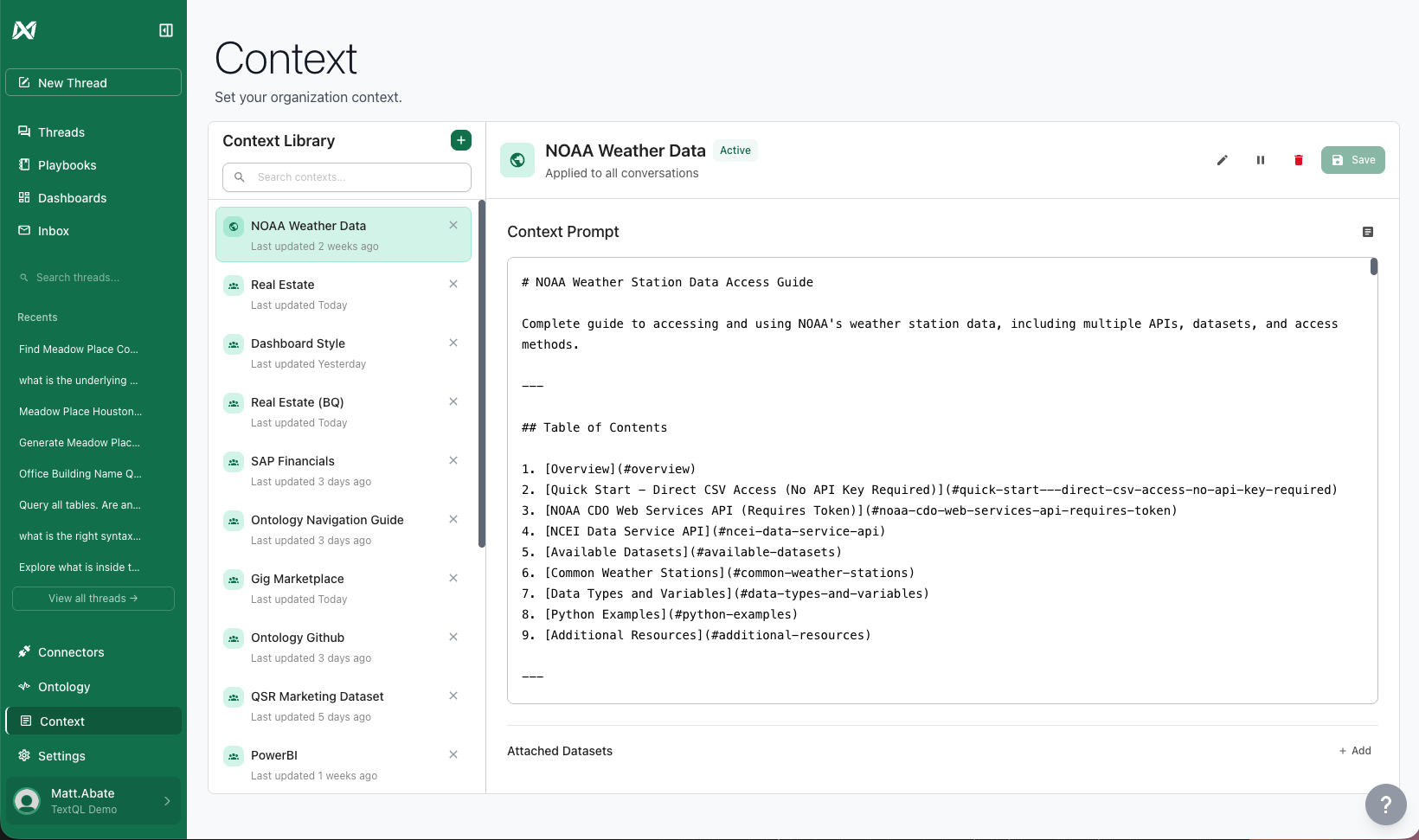
TextQL supports multiple types of context content:Plain Text & Markdown
Write context directly in the editor using plain text or markdown formatting for structure and clarity.
PDF Documents
Upload PDF files containing documentation, reports, or reference materials that Ana should understand.
PowerPoint Presentations
Share slide decks with business context, processes, or organizational information.
CSV Files
Provide reference data, lookup tables, or example datasets that inform Ana’s analysis.
How Ana Uses Context
When you chat with Ana, she automatically incorporates relevant context based on:- Your organization’s context: Applies to everyone in your organization
- Your role: Specific context for users with your assigned role
- Your active connector: Context specific to the data source you’re querying
- Role + Connector combination: Highly targeted context for specific role-connector pairs
Context vs. Other Features
TextQL offers several ways to customize Ana’s behavior. Here’s when to use each:| Feature | Best For | Example Use Case |
|---|---|---|
| Context | Business knowledge, processes, organizational info | ”Our fiscal year starts in July” or “Always format currency in EUR” |
| Ontology | Standardized metrics and business logic | Defining “Total Revenue” calculation that everyone uses |
| Datasets | Actual data files for analysis | Uploading a CSV of sales data to analyze |
| System Prompts | Advanced customization of Ana’s personality | Changing Ana’s communication style organization-wide |
What’s Next?
Ready to create your first context document? Learn how to use the context editor:Using the Context Editor
Learn how to create, edit, and manage context documents in TextQL’s native editor
Context Scoping
Understand how to apply context at different levels: organization, role, and connector
Related Features
GitHub Integration for Context
Connect Ana to a GitHub repository for version-controlled, reviewable context management
System Prompt Modification
Advanced customization of Ana’s behavior through system prompt configuration