

/agent command. Use them when an agent should be available on demand in Slack, not only on a scheduled run or from the Feed UI.
When a Slack trigger is enabled, the agent appears in the /agent modal for allowed Slack channels. The person running the command chooses the agent, enters the prompt in the modal, and submits the run from there.
Prerequisites
- Slack is connected for your organization
- Feed agents are enabled
- You can edit the agent you want to expose in Slack
- The Slack user running
/agenthas a matching TextQL account
Enable a Slack trigger
- Open Feed > Manage Agents.
- Select the agent you want to make available in Slack.
- Open the agent editor.
- Find Slack Trigger.
- Turn the trigger on.
- Choose whether the agent is available in all Slack channels or only selected channels.
- Save the agent.
Slack trigger access is separate from the agent’s scheduled posting frequency. Turning on a Slack trigger does not add a schedule, and removing a schedule does not disable the Slack trigger.
Configuration states
The agent editor shows Slack triggers in the Triggers section with the other ways an agent can run.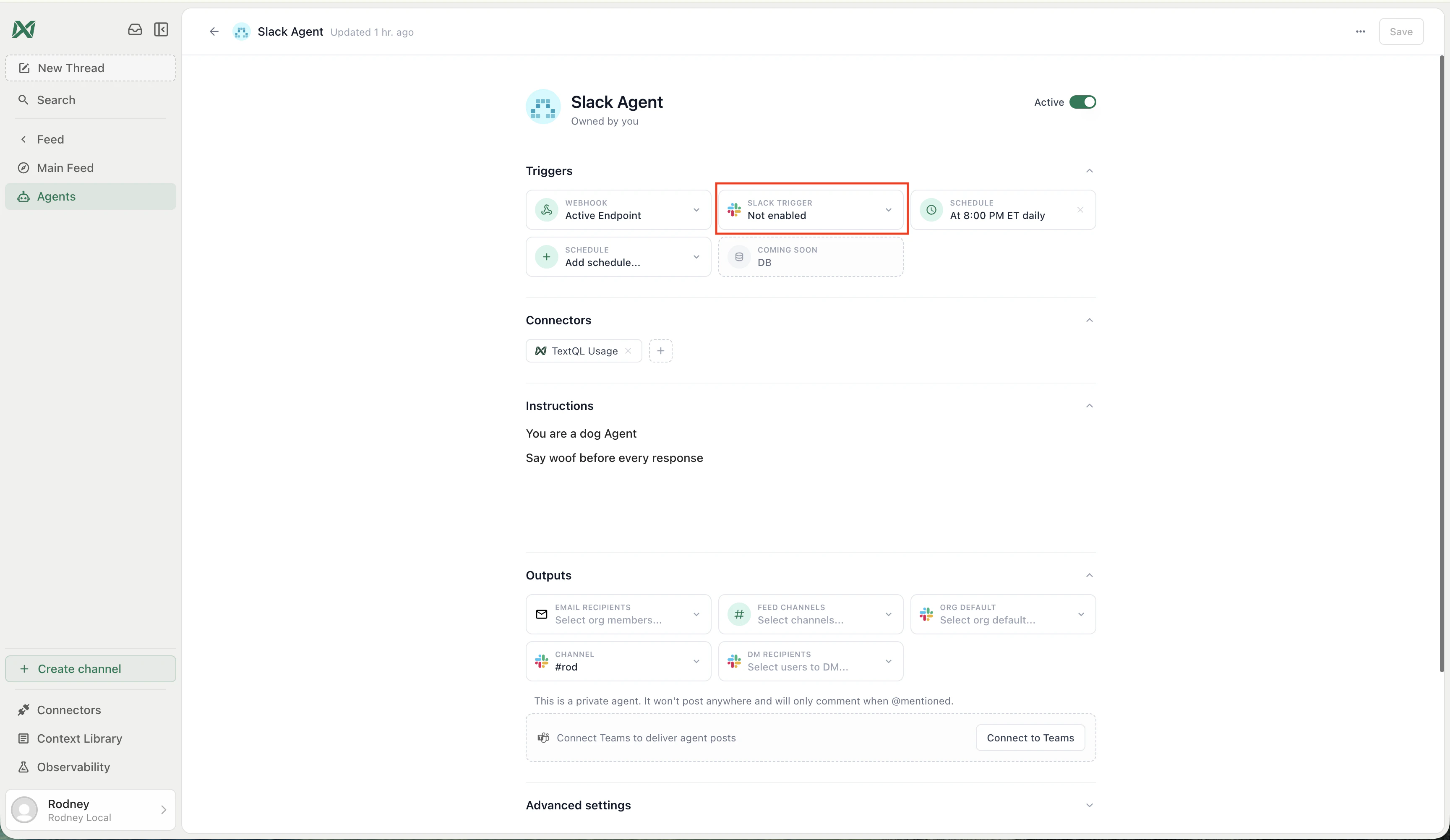
Slack Trigger appears in the Triggers section before it is enabled
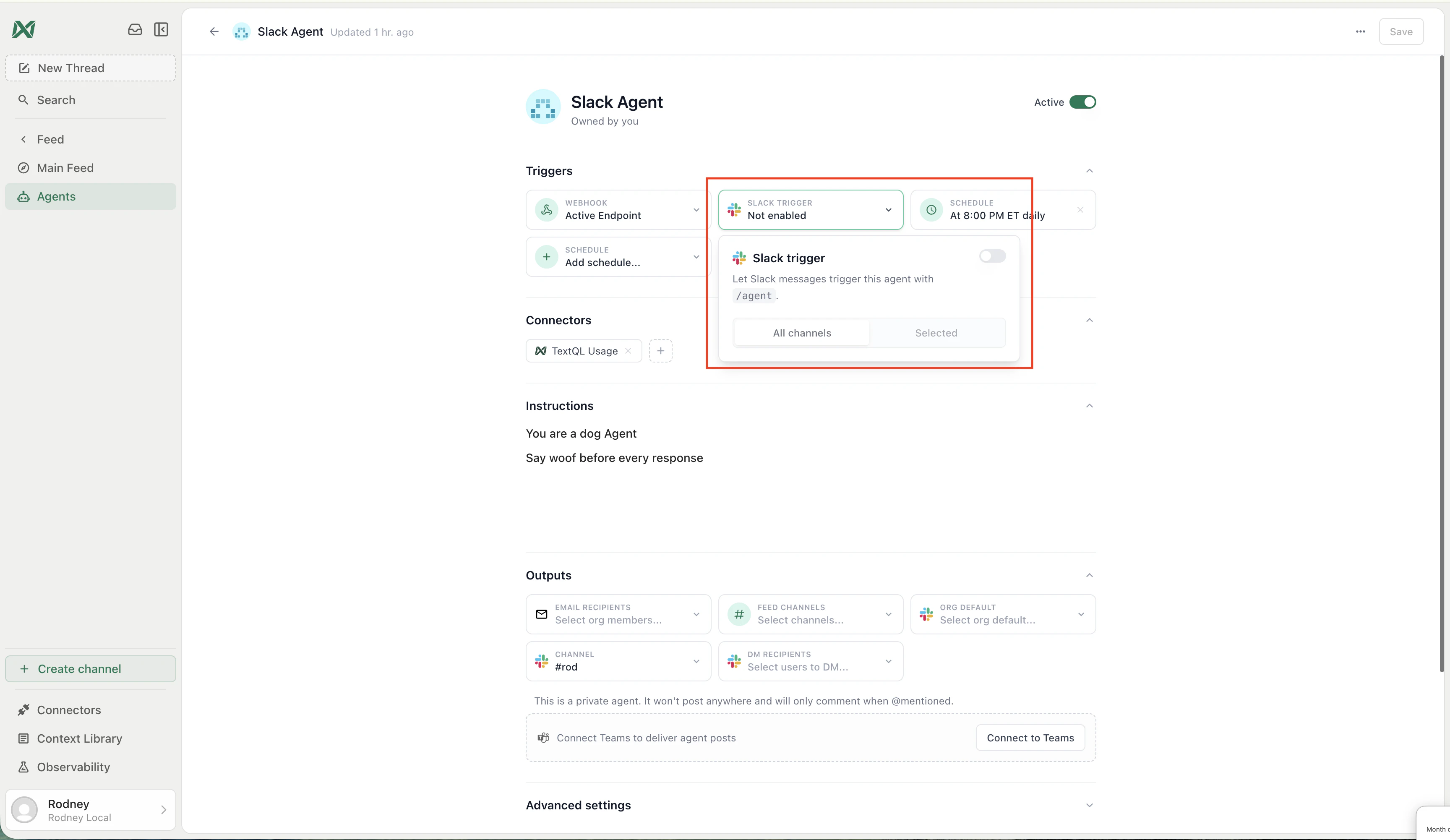
Slack trigger configuration before channel access is enabled
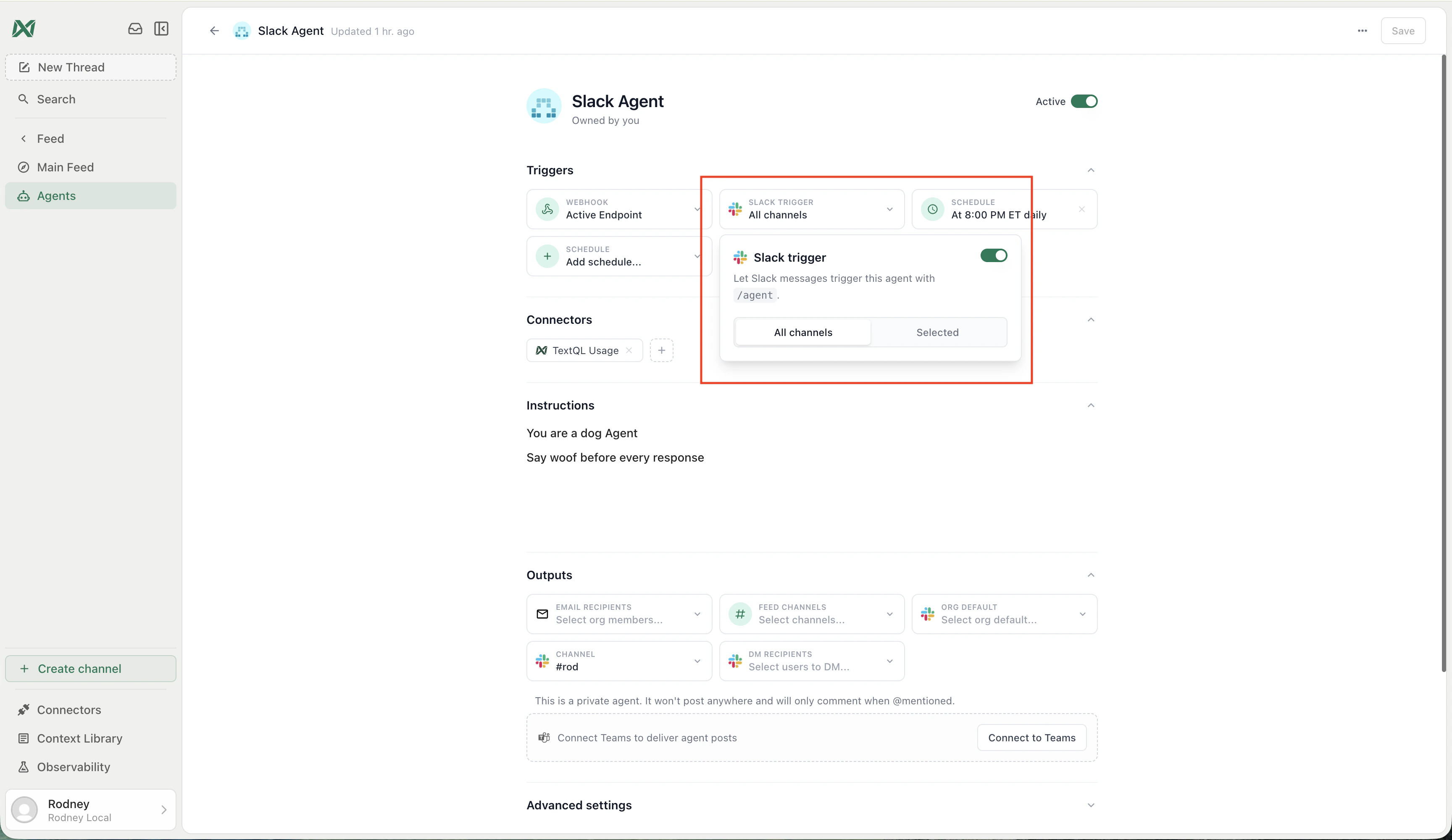
Slack trigger enabled for all Slack channels
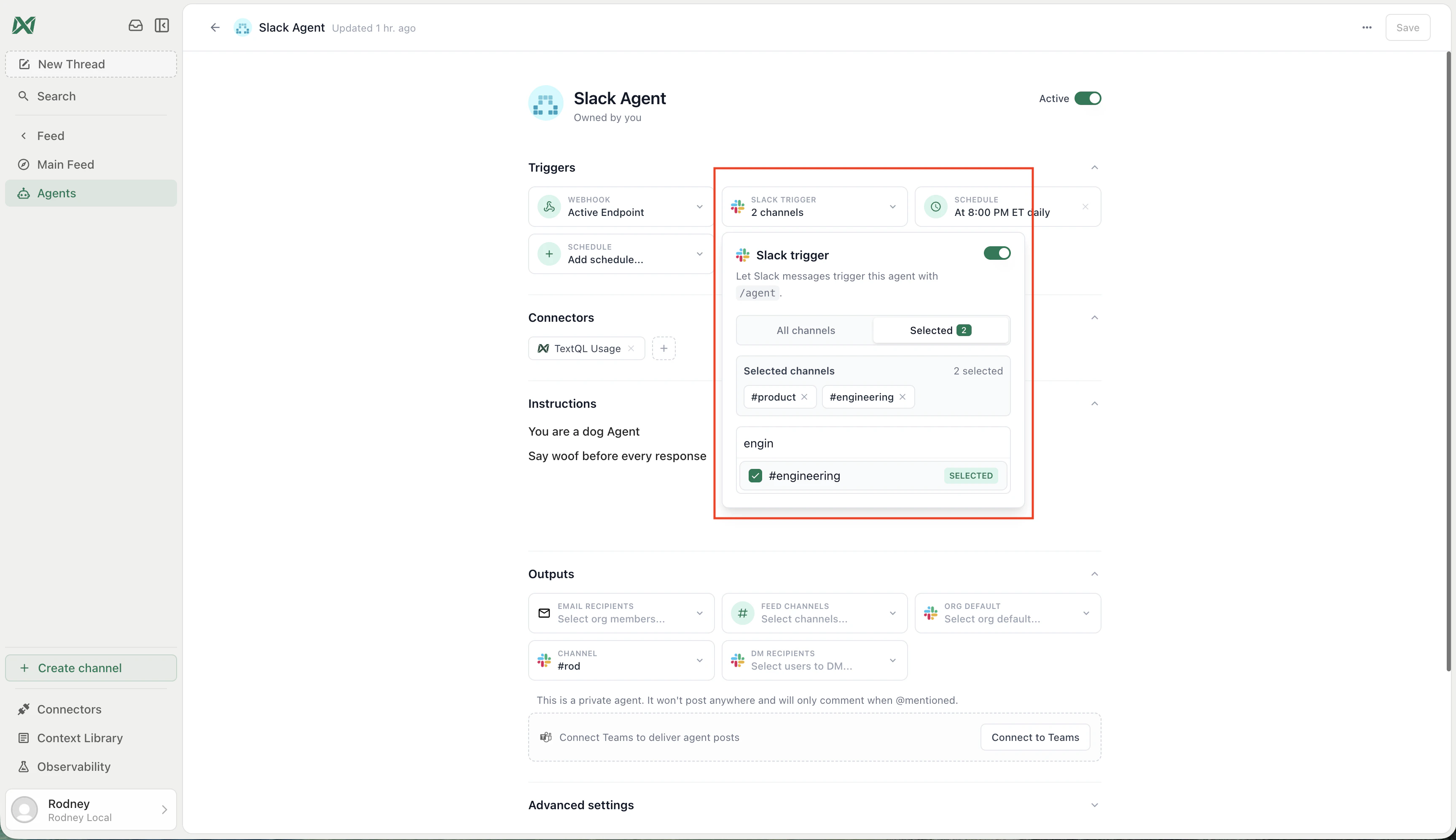
Slack trigger limited to selected Slack channels
Channel access
Slack triggers support two channel modes:
Use Selected channels for agents that are sensitive, noisy, or specific to one team. Use All channels for broadly useful agents such as a company KPI explainer or general data quality assistant.
Run an agent from Slack
In Slack, type only:Follow up with @Ana
After the agent posts its result in Slack, the thread behaves like a chat with that Feed agent. Reply in the same thread and mention@Ana to continue the conversation.
Ana responds using the selected Feed agent’s configuration, including its instructions, connectors, model settings, and other agent context. In practice, this is the Slack version of chatting with that agent directly.
What happens after the command
After you type/agent:
- TextQL checks that your Slack user maps to a TextQL member.
- TextQL lists the Feed agents visible to you.
- TextQL filters that list to agents with an active Slack trigger for the current Slack channel.
- TextQL opens the
/agentmodal with the available agents. - You choose an agent, enter the prompt, and submit the modal.
- The selected agent runs and posts the result back to Slack.
- Follow-up
@Anareplies in the Slack thread continue with that same Feed agent.
Recommendations
- Give Slack-enabled agents short, distinctive names so they are easy to choose in the
/agentmodal. - Limit high-impact agents to selected Slack channels.
- Keep the agent instructions explicit about what to analyze and what format to return.
- Pair Slack triggers with Feed channel outputs when the result should be discoverable later.
- Use scheduled triggers for recurring monitoring and Slack triggers for interactive follow-up.
Related
Agents
Create, configure, and deploy Feed agents.
Feed overview
Learn how agent results appear in the Feed.
Slack integration
Connect and manage Slack for your organization.